The game creates the necessary preference files and creates autoexec.cfg in /Library/Application Support/sauerbraten/. Note that while it is technically possible to run the Cube 2: Sauerbraten: Trooper Edition or earlier applications unmodified on Mac OS X 10.3.x Panther, this can cause unusual bugs that should not be reported.
Sauerbraten served with Kartoffelklöße (potato dumplings) | |
| Type | meat course |
|---|---|
| Course | main course |
| Place of origin | Germany |
| Region or state | throughout Germany and German-speaking regions. |
| Main ingredients | meat (usually beef, veal, venison or horse), marinated in wine and/or vinegar, vegetables, and spices |
Sauerbraten is a traditional German roast of heavily marinated meat. It is regarded as a national dish of Germany,and is frequently served in German-style restaurants internationally.[1] It can be prepared from a variety of meats, most often from beef, but also from venison, lamb and mutton, pork and horse.[2][3][4] Before cooking, the raw meat is marinated for three to ten days in a mixture of vinegar or wine, water, herbs, spices, and seasonings. Usually, tougher cuts of meat such as rump roast or bottom round of beef are used, and the long marinating tenderizes the meat.A Sauerbraten dinner is almost always accompanied by a hearty gravy resulting from its roasting and is most often served with potato pancakes (Kartoffelpuffer), potato dumplings (Kartoffelklöße), or Spätzle pasta.[5]
Ingredients used in the marinade, and accompanyments served with Sauerbraten, vary across regions. Regional variants of the dish include those from Franconia, Thuringia, Rhineland, Saarland, Silesia, and Swabia.[2]
Etymology[edit]
The name 'Sauerbraten' is of German origin and means 'sour roast'. The word derives from sauer meaning 'sour' or 'pickled' and Braten meaning 'roast meat'[6]
History[edit]
Julius Caesar has been assigned a role in the inspiration for sauerbraten as he sent amphoras filled with beef marinated in wine over the Alps to the newly founded Roman colony of Cologne. According to this legend (Julius Caesar was murdered in 44 BC and the Roman city of Cologne was founded in 50 AD), this inspired the residents of Cologne to imitate the Roman import.[7] While quite common, these claims are largely unsubstantiated.
Several sources believe sauerbraten was invented by Charlemagne in the 9th century AD as a means of using leftover roasted meat.[8][9]Saint Albertus Magnus, also known as Saint Albert the Great and Albert of Cologne, is also credited with popularizing the dish in the 13th century.[10][unreliable source?]
Sauerbraten was originally made from horse meat; this is still done by many traditional restaurants, particularly in the Rhineland, but today sauerbraten is most often made from beef.[3][11]
Regional variations[edit]
There are many regional variants of sauerbraten. Many of the variations are in the ingredients used for the marinade in which the cut of meat is immersed for several days before cooking.
Generally, the marinade's base is either red wine, vinegar or a combination of both. While Germany largely produces white wines such as Riesling and Gewürztraminer, regions of Germany that are closer to France often use red wine as the base for the marinade. Wine vinegar, apple cider vinegar and other varieties can be used as a base. Recipes from eastern regions of Germany closer to Poland and the Czech Republic tend to use vinegar as the base more frequently. In many regions, wine and vinegar are used together.
- Rheinischer Sauerbraten is prepared in Germany's Rhineland region—along the valley of the Rhine. Raisins and sometimes sugar beet syrup are added in cooking to provide sweetness to complement the sourness of the marinade.[7]
Preparation[edit]
Selection of the roast[edit]
Sauerbraten can be made with many different kinds of roasting meat. Tougher, less expensive cuts of meat are used—typically a rump roast or bottom round of beef.
Venison or other game are often prepared as sauerbraten as the spices and vinegar take away the gamey taste of the meat.[8]
Marinating the roast[edit]
A solid cut from the bottom round[12] or rump is marinated for three or four days,[13] or as many as ten,[14] before cooking.
Red wine vinegar and wine typically form the basis of the marinade, which also includes earthy aromatic spices such as peppercorns, juniper berries, cloves, nutmeg, and bay leaves and less commonly coriander, mustard seed, cinnamon, mace, ginger, and thyme.[3][15][16] The marinade may also include vegetables such as onions, celery, and carrots.[13] The acidic marinade helps tenderize the meat before it cooks. Buttermilk is also used as a marinade in certain regional varieties.[5][17]It is frequently advised to marinate the meat in an earthenware, glass, plastic, or enamel container rather than one made of bare metal, as the acidic marinade would react with a metal vessel during the extended marinating.
Cooking the roast[edit]
After the meat is removed from the marinade and dried, it is first browned in oil or lard and then braised with the strained marinade in a covered dish in a medium oven or on the stovetop. After simmering for four hours or more, depending on the size of the roast, the marinade will continue to flavor the roast and, as the meat cooks, its juices will also be released resulting in a very tender roast.
Preparing the gravy[edit]
After the roast is cooked, the marinade is strained and returned to a saucepan where it is thickened (often with crushed gingerbread, lebkuchen, or gingersnaps, flour, sour cream, brown sugar, and/or roux)[3][18] which add body and flavor to the sauce. Before it closed in 1982, Luchow's German restaurant in New York City used crushed gingersnap cookies to season and thicken the gravy of its sauerbraten, one of the favored dishes.[5][19] This style was made popular in the U.S. after the publication of Luchow's German Cookbook: The Story and the Favorite Dishes of America's Most Famous German Restaurant by Jan Mitchell in 1952.[13]
Other[edit]
Packaged sauerbraten seasonings are available.[20][21] Cooked sauerbraten in marinade is sold in some supermarkets.
While sauerbraten is most traditionally eaten with beer,[22] it pairs well with the following wine varietals: Burgundy,[23]Cabernet Franc, Cabernet Sauvignon, Gewürztraminer, Pinot noir, Riesling, and Syrah.[24][unreliable source?]
Notes[edit]
- ^Garrett 1898
- ^ abSheraton 1965, p. 147.
- ^ abcdKummer 2007, p. 553.
- ^Casada 1996, p. 30.
- ^ abcSaekel 2005, F-5.
- ^The American Heritage Dictionary of the English Language (4th Ed.). (2006)
- ^ abHassani 2004, p. 156.
- ^ abSchmidt 2003, p.94.
- ^Herter 1995.
- ^April 2 Today's Events in Food History
- ^Babcock 2002 p. 248.
- ^The Culinary Institute of America Publisher 2006, p. 178.
- ^ abcMitchell 1953, p. 106.
- ^Sales 1977, p. 176.
- ^Sauerbraten Blend of Whole Spices
- ^Wood 1983, p.95.
- ^Richards 1966, p. 182.
- ^Youngkrantz 1997, p. 105.
- ^O'Neill 1992, p. 181.
- ^Knorr Entree Mixes-Pot Roast (Sauerbraten) Recipe Mix, 2-Ounce Packet (Pack of 12): Amazon.com: Grocery & Gourmet Food
- ^Alba Sauerbraten Spices, 0.53-Ounce Packets (Pack of 12): Amazon.com: Grocery & Gourmet Food
- ^Jackson 1998, p.53.
- ^Mitchell 1953, p. 107
- ^Sauerbraten Wine Pairing | Food and Wine Pairings | Pair Food and Wine
References[edit]
- Babcock, Erika M. L. (2002). Rika's Stories from the Other Side. IUniverse.
- Barer-Stein, Thelma (1999). You Eat What You Are. A FireFly Book.
- Casada, Jim & Casada, Ann (1996). The Complete Venison Cookbook: From Field to Table. Krause Publications.
- Garrett, Theodore Francis (Ed.) (1898). The Encyclopedia of Practical Cookery. L. Upcott Gill, 170, Strand, W.C. London. Vol. III.
- Hassani, Nadia (2004). Spoonfuls of Germany: Culinary Delights of the German Regions in 170 Recipes. Hippocrene Books.
- Herter, George Leonard & Herter, Berthe (1995). Bull Cook and Authentic Historical Recipes and Practices (9th ed.). Ecco.
- Jackson, Michael (1998). Ultimate Beer. DK ADULT.
- Kummer, Madison (2007). 1,001 Foods to Die For. Andrews McMeel Publishing.
- Mitchell, Jan (1953). Luchow's German Cookbook: The Story and the Favorite Dishes of America's Most Famous German Restaurant. Garden City, New York: Doubleday & Company, Inc.
- O'Neill, Molly (1992). New York Cookbook: From Pelham Bay to Park Avenue, Firehouses to Four-Star Restaurants. Workman Publishing Company.
- Richards, Lenore & Treat, Nola (1966). Quantity Cookery: Menu Planning and Cooking for Large Numbers (4th ed.). Little, Brown, & Co.
- Saekel, Karola (December 28, 2005). 'Sauerbraten recipe surfaces just in time'. San Francisco Chronicle, F-5.
- Sales, Georgia (1977). The Clay Pot Cookbook. Wiley & Sons.
- Schmidt, Gretchen (2003). German Pride: 101 Reasons to Be Proud You're German. Citadel Press.
- Sheraton, Mimi (1965). The German Cookbook: A Complete Guide to Mastering Authentic German Cooking. Random House.
- The American Heritage Dictionary of the English Language (4th ed.). (2006) Houghton Mifflin Company.
- The Culinary Institute of America (2011). The Professional Chef (9th ed.). Hoboken, New Jersey: John Wiley & Sons. p. 587. ISBN978-0-470-42135-2. OCLC707248142.
- Wood, Morrison (1983). Through Europe with a Jug of Wine. Farrar, Straus and Giroux, p. 95.
- Youngkrantz, Gini (1997). Authentic German Home Style Recipes (4th ed.). B. G. Youngkrantz Company.

| Cube 2: Sauerbraten | |
|---|---|
| Developer(s) | Wouter van Oortmerssen, Lee Salzman, Mike Dysart[1] |
| Designer(s) | Wouter van Oortmerssen |
| Composer(s) | Marc A. 'Fanatic' Pullen[1] |
| Platform(s) | Microsoft Windows, Linux, FreeBSD, OpenBSD, OS X, Unix |
| Release | May 6, 2004 |
| Genre(s) | First-person shooter |
| Mode(s) | Single-player, multiplayer |
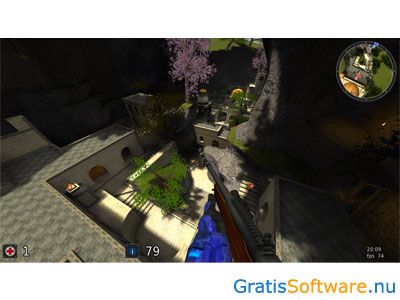
Cube 2: Sauerbraten (German for 'sour roast', also known as Sauer) is a cross-platform, Quake-like first-person shooter that runs on Microsoft Windows, Linux, FreeBSD, OpenBSD[2], and Mac OS X using OpenGL and SDL. The game features single-player and multiplayer gameplay and contains an in-game level editor. The game engine is free and open-source software, under the zlib License,[3] with commercial support available from the developer's business counterpart, Dot3 Labs.[4] The game media is released under various non-free licenses. The aim of the project is not to produce the most features and highest-quality graphics possible, but rather to allow map-editing to be done in real-time within the game, while keeping the engine source code small and elegant.
Gameplay[edit]
The game has singleplayer and multiplayer modes. Multiplayer functionality is possible with LAN, local, and online play. The Online play gets its server listings from a master server. Offered gameplay modes are Free-For-All (deathmatch), Capture (where teams fight for control of points on the map, all weapons allowed), Capture the Flag (two teams fight to capture the other's flag and return it to their base), Teamplay (defeat the other team's players to score points for your team), Tactics (FFA, but players spawn with random equipment), Efficiency (FFA, but players spawn with all equipment) InstaHold, where two teams have to possess a single flag for a minimum of 20 seconds to score points; Collect (kill enemy players and collect their skulls, which then have to be returned to the home base), and Protect (teams try to touch each other's flag). Instagib (rifles only, 99 pieces of ammo, one shot kill, no pick-ups), regenerative weapons, and Teamplay versions of some of the game modes are available, as well as online cooperative map editing—one of Cube 2's most interesting and popular features. There are also single-player modes featuring both episodic gameplay and deathmatches on multiplayer maps with AI bots instead of human opponents.
History[edit]
Development[edit]
Cube 2: Sauerbraten started as a redesign of the original Cubegame engine.[5][6]
The Cube 2: Sauerbraten engine is written in C++ and OpenGL. Cube 2: Sauerbraten shares most of its design goals and philosophy with its predecessor, but using a new 6-directional heightfield (or octree) world model.
Releases[edit]
Its first, developer-only, release was made on February 27, 2004.[7]
One of the latest releases, dubbed the 'Justice Edition', debuted on July 19, 2010,[8] adding two new player models, thirty new user-created maps, several new game modes, including Efficiency CTF, Efficiency Hold, Efficiency Protect, Hold, and InstaHold; a mini-map, clock, and crosshairs, among various other things. The latest release is called 'Collect Edition' and was released on January 4, 2013.
Derivatives and forks[edit]
Tesseract is both an improved version of the Cube 2 game engine and is also a fork from the Cube 2 Sauerbraten game. The game offers better graphics, but has higher system requirements.[9][10][11][12]
Inexor is a fork of Cube 2 intended to add more functionality. Eventually, it hopes to replace Sauerbraten.[13][14]
Red Eclipse was a fork of Cube 2 with improvements to the engine featuring a different gameplay. With version 2.0 it has been ported to the Tesseract engine.[15][16]
In 2012 a Mozilla researcher, Alon Zakai, created a browser based demo called BananaBread by using Emscripten to port the C++ code into JavaScript and WebGL.[17]
Features[edit]
Rendering engine[edit]
Cube 2's rendering engine is designed around modern graphics processing units, which perform best with huge batches of geometry already stored in video memory. Lighting is precomputed into lightmaps—image files that correspond to geometry as textures—for efficient batching, with an additional stored directional component, that allows for efficient shader-based lighting effects. The original Cube engine's rendering engine assumed that overdraw (where polygons that do not appear in the final scene are occluded via the z-buffer) was more processor-intensive than sending new streams of triangles to the graphics processing every frame, which vastly limited its performance on more modern hardware where memory bandwidth is a greater limiting factor. The most recent releases (starting with 'CTF Edition') support a precomputed visibility system (PVS) for graphics cards that do not support hardware occlusion.
Real-time editing[edit]
Cube 2: Sauerbraten uses a 6-directional heightfield (or octree) world model. An octree, in Sauerbraten, is a cube that can be split into eight smaller cubes; those smaller cubes are also octrees, and can be subdivided further. This allows much more complex level geometry and easier editing.
Each cube-shaped node in the octree represents a renderable volume, or a type of Marching cube, which are referred to as a cube, where each edge of this cube can be lengthened or shortened to deform the cube into a variety of other shapes. Corners of cubes can also be 'pushed' or 'pulled' to create crude curves. The what you see is what you get realtime editing has enabled level designers to add a lot of detail to maps, while reducing the time spent on actual creation. This is in contrast to traditional modern polygon soup 3D engines which take a model generated as an essentially random batch of triangles from an external modelling program and attempt to spatially subdivide the model's triangles after the fact by splitting them to fit into tree structures, such as a BSP tree or even an octree, that require costly pre-processing to build. Cube 2's novelty thus lies in that the world representation is the octree, or Marching cubes, structure itself, from which efficient triangle batches are generated for the graphics processing unit to render, without need for expensive and time-consuming pre-processing.[18]
Reception[edit]
The game has been shown in a Burger Kingtelevision commercial.[19][20] It also received four out of five stars in a MacWorld UK review[21] and was mentioned in Issue 3 of Games for Windows: The Official Magazine (as well as their '101 Free Games' article), where it was described as being 'perfect for both stingy and creative gamers alike'.[22]
The 'CTF Edition' was reviewed positively by Phoronix, a Linux-focused hardware and software review website,[23] as well as Linux.com,[24] a website providing news related to free and open-source software.
The game was quite popular; between 2004 and May 2017 the game was downloaded alone from Sourceforge.net over 5.3 million times.[25]
See also[edit]
References[edit]
- ^ abSauerbraten Team (2009). 'Sauerbraten Credits/Authors'. sauerbraten.org. Sauerbraten. Retrieved May 14, 2009.
- ^https://cvsweb.openbsd.org/ports/games/sauerbraten/Makefile
- ^Sauerbraten Team (2008). 'Sauerbraten License'. sauerbraten.org. Sauerbraten]. Retrieved June 12, 2008.
- ^Dot3 Labs (2008). 'Dot3 Labs - Sauerbraten Technology'. dot3labs.com. Dot3 Labs]. Retrieved June 12, 2008.
- ^'Sauerbraten FPS Updated'. insidemacgames.com. Inside Mac Games. 2007-04-18. Retrieved 2009-04-15.
- ^'Sauerbraten 2008_06_20'. macupdate.com. MacUpdate. Archived from the original on 2009-05-14. Retrieved 2009-04-15.
- ^Wouter van Oortmerssen (2004). 'Sauerbraten's initial release'. sourceforge.net. SourceForge. Retrieved July 9, 2010.
- ^'Cube 2: Sauerbraten - History'. sauerbraten.org. Sauerbraten. 2010. Retrieved July 19, 2010.
- ^Salzman, Lee (April 18, 2012). 'Announcing Tesseract...'
- ^Larabel, Michael (April 24, 2012). 'Cube 2's Tesseract Vastly Improves Graphics'.
- ^Tesseract page
- ^Lee Salzman's page, creator of Tesseract
- ^'Inexor | Stays sauer, becomes better'. inexor.org. Retrieved 2016-11-20.
- ^'inexor-game/code'. GitHub. Retrieved 2016-11-20.
- ^'Red Eclipse: A free arena shooter featuring parkour'. www.redeclipse.net. Retrieved 2019-10-10.
- ^'Red Eclipse: Documentation - Information for v2'. www.redeclipse.net. Retrieved 2019-10-10.
- ^Paul, Ryan. 'Firefox 15 arrives, supports compressed textures for impressive 3D gaming'. Ars Technica. Retrieved August 29, 2012.
- ^Wouter van Oortmerssen. 'Sauerbraten initial development documentation'. Retrieved August 21, 2013.
- ^Wouter van Oortmerssen (2006). 'Sauerbraten in Burger King TV commercial!!'. cubeengine.com. Cube Engine Games]. Retrieved February 22, 2007.
- ^'Burger_King_Girlfriend_out_of_town_DC_25sec.mpg'. sauerbraten.org. Archived from the original on 2007-03-07. Retrieved 2007-02-22.
- ^Hodge, Karl (2007-06-29). 'Cube 2: Sauerbraten Review'. macworld.co.uk. MacWorld UK. Retrieved 2007-07-17.
- ^Games for Windows: The Official Magazine, p. 58, February 2007Missing or empty
|title=(help) - ^Larabel, Michael (2008-06-21). 'Sauerbraten CTF Edition'. phoronix.com. Phoronix. Retrieved 2008-06-22.
- ^Sharma, Mayank (2008-08-26). 'Frag 'em in your own backyard with Sauerbraten'. linux.com. Linux.com. Retrieved 2008-08-28.
- ^stats 2000-05-18+to+2017-05-24 on Sourceforge.net (May 2017)
External links[edit]
| Wikimedia Commons has media related to Cube 2: Sauerbraten. |
Sauerbraten Game For Mac Os
- Sauerbraten project at SourceForge.net
- BananaBread project on Github.com
- Inexor project at Github.com