Mar 07, 2014 Discuss: Apple MacBook Pro (15-inch, 2013) review: Apple's high-end laptop gets better battery life and a lower price Sign in to comment Be respectful, keep it civil and stay on topic. Pes 2013, short for Pro Evolution Soccer 2013, by KONAMI. This is a well-known football video game which is considered to be the chief competitor of the famous FIFA series. Sadly, Pes 2013 for Mac is not available at the moment, therefore, you might want to find other football games to play on your system.
Oct 25, 2013 The Apple MacBook Pro 15-inch (2013) earns its title as one of the best high-end desktop replacement laptops you can buy. It has the power of a desktop Mac, and the battery life to carry you.
Standing in a Best Buy is an odd time for an existential crisis. Yet it's an almost certain occurrence, at least when you're there shopping for a laptop. More so than with any other product category, buying a laptop forces you to make all manner of decisions and prognostications about yourself. Do I play games? Will I want to play games sometime in the next four years? How much do I travel? How much will I travel? Am I going to be using Office much, or at all, or ever again? I have cable now, but am I going to become a cord-cutting Netflix aficionado sometime before I'm back here shopping for another new laptop?
Everything's a choice with laptops, everything a tradeoff. You want power, you're going to need a big, expensive, probably ugly machine. You want long battery life and a slim build, gaming's all but out the window. Good speakers and screens are hard to come by; so are great keyboards and trackpads. There's no such thing as having it all, no matter what you're willing to pay for it.
That's why the new 13-inch MacBook Pro is so intriguing. It's powerful, but it's not much thicker than the MacBook Air or your average Windows ultrabook. It has a great screen, and Apple claims it'll last for up to nine hours. On paper, it looks like the perfect balance: pretty portable and pretty powerful, in a pretty package. And it starts at $1,299, only $100 more than the same-size MacBook Air and $400 less than last year's model.
The 13-inch Pro is made for everyone. But for that kind of laptop, there's always a catch — a terrible trackpad here, a hideous heat or battery problem there. Last year it was the Pro's processor, which all too often appeared to be teetering on the edge of its capabilities. There has to be a catch this year too, right?
When Pro met Air
Apple's laptop design isn't perfect — the MacBooks still have sharp edges that dig into my wrists, and the silver aluminum chassis picks up dings and discolorations too easily for my liking — but it's close. It's consistent, too: the MacBook look hasn't changed in years. Still as sturdy and minimalistically handsome as ever, the 13-inch Pro is largely unchanged from last year's model.
It still has a big, roomy, class-leading glassy trackpad, with responsive gestures and two-finger scrolling. It also still has a roomy, clicky black keyboard, with a customizeable backlight and slightly more travel than the MacBook Air. Neither has changed in years, and neither really needs to — other manufacturers still need to catch up. I do wish Apple would upgrade its speakers: audio comes through the Pro's keyboard, and is tinny and shallow.
The port arrangement is the same as the 15-inch model, and the same as last year's 13-inch Pro: with two Thunderbolt 2 ports, two USB 3.0 jacks, a headphone jack, and an SD card slot, there's little want for more anyway. All that's technically new is a second hole for a second microphone, which Apple says is for noise cancellation; I can't say for sure that it works, but it definitely doesn't make anything worse.
Slowly, the Pro appears to be inching downward toward the Air lineup. This year's model is a little thinner than last year's — 0.71 inches rather than 0.75 — and weighs 3.46 pounds instead of 3.57. It's only a hair thicker than the Air, and about a half-pound heavier; it's not nearly the sacrifice the 15-inch model is.
DisplayGive and take
In exchange for the slight extra weight over the Air, the 13-inch Pro offers a gorgeous, 13.3-inch, 2560 x 1600 display. It's no longer the only beautiful display on the market — the Toshiba Kirabook, the Acer Aspire S7, the Samsung Ativ Book 9 Plus, and a handful of other notebooks offer equally stunning screens — but it's absolutely gorgeous. It's essentially taking a 1280 x 800 display and displaying four pixels in each spot, and the result is clear text, crisp lines and details, and a screen you really don't want to take your eyes off.
You trade half a pound and $100 for a stunning display
The problem is simple real estate — 1280 x 800 isn't that much screen space. I can see more on my 13-inch, 1440 x 900 Air than on the 13-inch Pro (though everything on the Pro is far nicer to look at). You can set the resolution to a maximum of 1680 x 1050, but it makes text squint-inducingly tiny, and since the display can't pack an even number of pixels into that resolution things look a little blurrier as well. And there are plenty of icons, websites, and apps that still haven't been updated for this new high-res world, and the things that haven't been optimized look pretty terrible. But be all that as it may, I'd trade the Air's screen for the Pro's without a moment's hestitation.
My only concern with making that swap would be that the Air's processor and graphics card can't handle pushing that many pixels. Last year's Pro barely even could. But this year, the Pro's much more ready for the task.
PerformanceThe MacBook Middle
Considering the 13-inch MacBook Pro in the same class as the 15-inch model I reviewed last week is almost unfair. That machine was a beast, a gaming and productivity powerhouse — the 13-inch Pro is not. My review unit is powered by a 2.4GHz dual-core Intel Core i5 processor, one of the latest-generation Haswell chips, along with 8GB of RAM and 256GB of solid-state storage. Configured this way, the 13-inch Pro costs $1,499; for $1,299 you get the same processor, 4GB of RAM, and 128GB of storage. You can also upgrade to 512GB of storage and a 2.6GHz processor for $1,699, and there are configurations up to 1TB of storage and 16GB of RAM. Since this is a computer you'll have for a while, and since none of the components are easily upgraded, it's worth spending a little more now.
Budget carefully when you're picking a MacBook Pro
One thing you can't customize are Intel's Iris graphics, which are responsible for constantly powering the 13-inch Pro's pixel-rich display. As with last year's model, I noticed a distinct difference between it and the Iris Pro-powered 15-inch Pro, and especially compared to the larger model with discrete graphics (an Nvidia chip that isn't an option at 13 inches). Heavy websites like The Verge stutter occasionally, in a way that's so familiar to my Air as to be unnoticeable, but that can't compare to the buttery smoothness of the larger Pro. I was able to play two 1080p videos side by side without issue, but a third would occasionally make another jerk through a few frames.
In everyday use, the Pro feels roughly like my Air. With a GeekBench score of 6,303, it's also far closer to the Air (6,057) than to the larger Pro (13,503). It's just perfectly competent and efficient, and that's plenty. It boots in about 15 seconds, and resumes from sleep almost instantly. My daily routine involves a dozen or so tabs, YouTube, Rdio, occasional gaming or Netflix, and perpetual Command-Tabbing between 10 or 15 apps. It handles all of that, and even some image or video editing, without a problem.
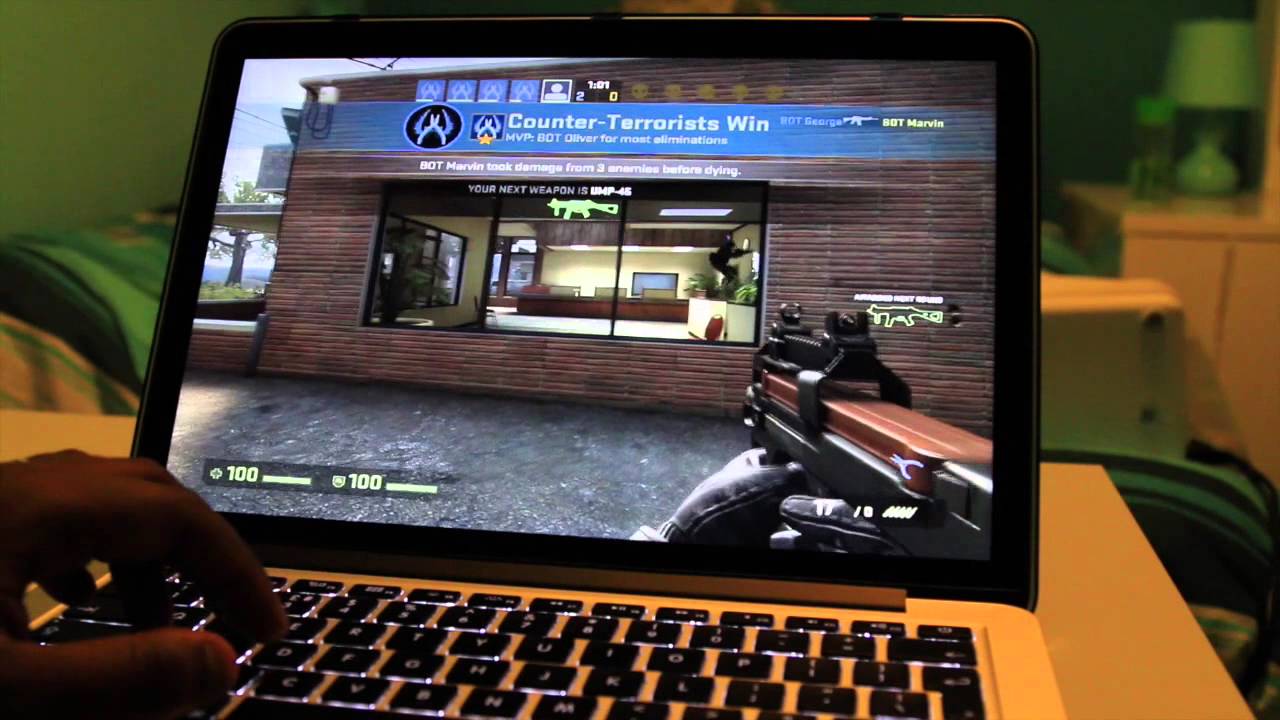
I could even play Portal 2 (on the subway or anywhere else) without problems at medium settings, though it's not a particularly intensive game. At high settings, Bioshock Infinite stuttered badly enough to give me a headache, but it became playable at lower settings before graphics got too bad. The Witcher 2 was basically unplayable any way I sliced it. During all three games, the Pro got a little warm and very loud, which almost never happened otherwise. This is not a gaming laptop, and any serious gamer should look to Windows machines anyway — from the Alienware 14 to the Razer Blade true gaming power, and most of the games, are reserved for Windows users. But for everything from movie watching to movie making, the 13-inch Pro holds up nicely.
I never had the overwhelming sense of power I got from the 15-inch model, as if I could solve world hunger or topple foreign governments with the spare processing cycles in my computer. And if you want a device with headroom, that's going to be plenty powerful for years to come, the 13-inch Pro probably still isn't your best option. But for most people, for most uses, what in practice amounts to a MacBook Air with Retina display is an excellent idea.
And here's the best part: even with all those pixels, the 13-inch MacBook Pro still lasted 10 hours, 7 minutes on the Verge Battery Test. That may not be the 13 hours and 29 minutes the Air lasted, but it's more than almost any other laptop, and more than enough to last you a cross-country flight's worth of movies or through a daylong meeting. Part of that is due to the ultra-efficient Haswell chips, part due to the power improvements in OS X 10.9 Mavericks, but whatever the reasons, the net result is a Retina MacBook that can last all day and then some.
Not quite a perfect mix, but an excellent middle ground
In 2008, the $1,299 13-inch MacBook was the de facto Apple laptop. The Air was $1,800 and totally unreasonable for most people, and the 15-inch Pro was big and bulky and designed only for power users. The 13-inch model wasn't the cheapest computer, or the most powerful, or the longest-lasting, but it did everything well.
Five years later, we've come back around. The $1,299 13-inch MacBook Pro isn't the cheapest Apple computer (that's now the Air), or the most powerful (that's the 15-inch Pro), or the longest-lasting (the Air again). But it does everything well.
The primary question is whether you should spend $100 more than the comparable MacBook Air and get the 13-inch Pro. The calculation is simple: you trade a half-pound and about three hours of battery life for an absolutely stunning display and a handful of extra ports. (The display requirements negate the spec gains in most practical ways.) Personally, my laptop goes everywhere I go, and I'll take smaller and lighter any way I can get it. But for most people, it's going to be a tough call.
My guess? More than a few people will take one look at that screen and wind up leaving Best Buy with one less existential crisis and one more MacBook Pro.
BestMacBook for GamingiMore2020
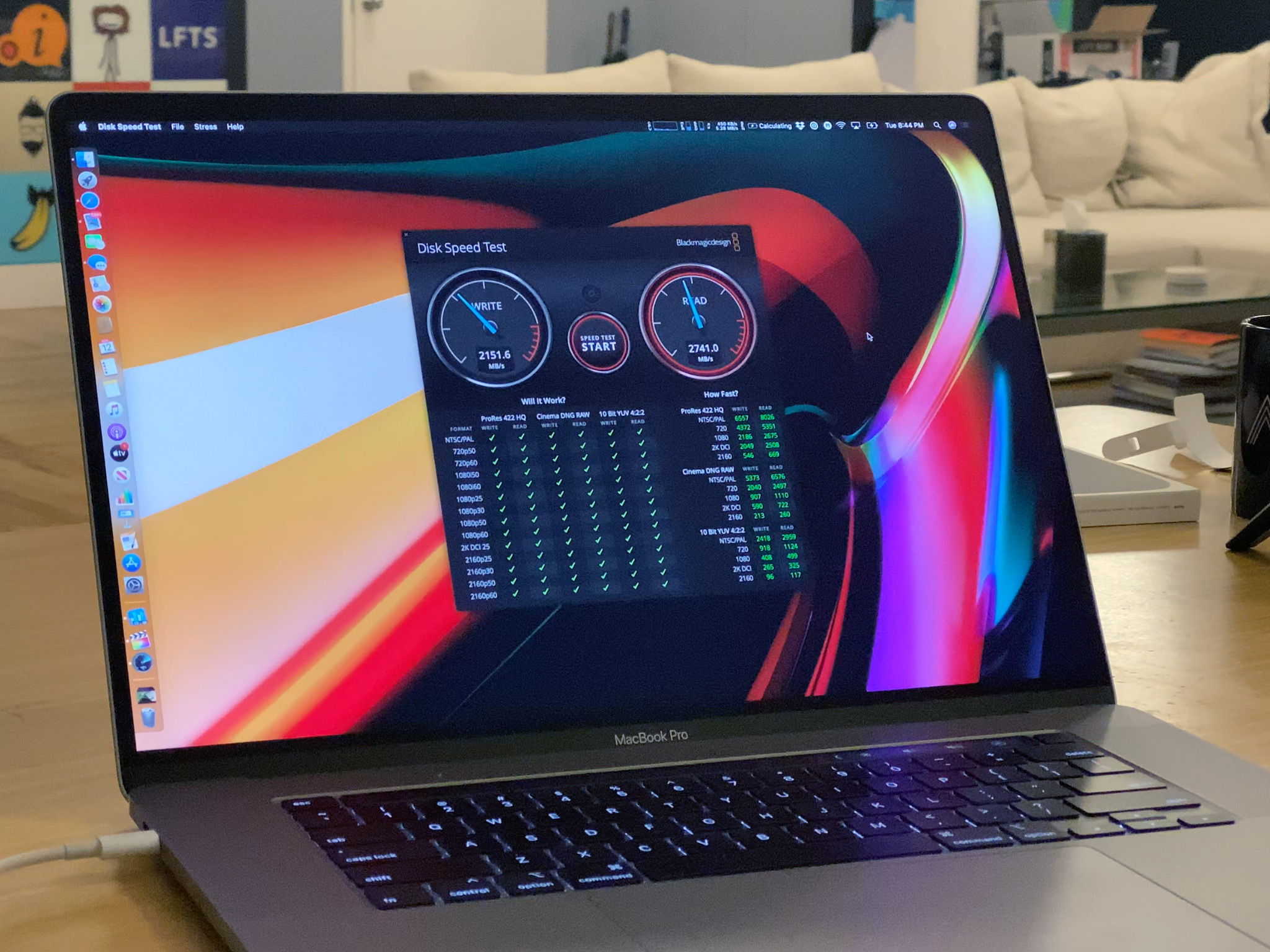
Apple MacBooks have never been designed to perform solely as gaming laptops. Despite this, some models are better than others for this type of use. Our favorite current model, the 16-inch MacBook Pro (2019) i7 processor, includes numerous features that make it a terrific device for casual gamers. There are other noteworthy models we've gathered to help you choose the one that fits your needs best.
Best Overall: 16-inch MacBook Pro (2019) i7 processor
For gamers, we're recommending the least expensive of the two 16-inch models, which includes a 9th-generation Intel Core i7 processor with Turbo Boost up to 4.5GHz. We're picking this one because it offers a nice mix of features at a price that's far more affordable than the premium offering we highlight below.
The base 16-inch MacBook Pro comes with 16GB 2666MHz DDR4 memory, 512GB SSD storage, and four Thunderbolt 3 ports. The model comes standard with an AMD Radeon Pro 5300M with 4GB of GDDR6 graphics processor that you can upgrade to an AMD Radeon Pro 5500M with 4GB of GDDR6 or an AMD Radeon Pro 5500M with 8 GB of GDDR6 for better performance.
On the obvious downside, this is still an expensive laptop. Plus, you'll need to recharge this laptop more often than the MacBook Air. And like all MacBooks, it isn't usually on sale at a discount.
Pros:
- The least expensive 16-inch model
- Pay extra for a graphics boost
- Biggest MacBook Pro display to date
Cons:
- Still very expensive
- Not the most powerful MBP you can buy
- Up to 11 hours wireless web
Best Overall
16-inch MacBook Pro (2019) i7 processor
Largest display for less
The entry-level 16-inch MacBook Pro is an excellent choice for the occasional computer gamer.
Source: iMore
Much lighter than the 13-inch MacBook Pro that has the same screen size, the 2019 MacBook Air weighs just 2.75 pounds, making it a great take-and-go laptop. Along with being less weighty, the MacBook Air provides an hour more of use between charges, although actual performance depends on the tasks.
We're sold on the entry-level MacBook Air, even for gaming, because of its price. Still, think casual gaming here only thanks to its slower processor and graphics card. There's also fewer Thunderbolt 3 ports on this model.
If you're purchasing a laptop solely for gaming, this isn't the one to buy. However, it will work well in a pinch when you need to take a break from your studies or work.
Pros:
- Same screen size as 13-inch MBP
- Up to 12 hours of wireless web between charges
- Excellent price
Cons:
- Only two Thunderbolt 3 (USB-C) ports
- Not as powerful as MBP models
Best Value
MacBook Air (2019)
Save money and still game
Casual-casual gamers will enjoy using this MacBook Air model during the occasional break from work or school.
Source: iMore
When it comes to the 2019 13-inch MacBook Pro, $500 separates the base and most complete package. For even more, you can upgrade the machine's For the five memory, storage, and processor.
The smaller of the two MacBook Pro models is a great overall pick. At just over three pounds, the 13-inch MacBook Pro is only slightly heavier than the MacBook Air. For this, you get a better processor and graphics card, more storage availability, and a Touch Bar. You can upgrade the processor and storage. In doing so, however, you'll push the price just shy of $2,000. If that happens, you might want to consider our No. 1 pick instead.
Regardless, if a 13-inch display is what you want and you want the bells and whistles missing on the MacBook Air, this is the one to get. If you intend to spend more than one-fourth of your time gaming, it's even more vital for you to consider this model over the Air.
Pros:
- Better internals than MacBook Air
- Great mobility
- Much cheaper than the 16-inch model
Cons:
- You can't upgrade the graphics card
- Price can rise as you add components
- Is 13-inches enough?
Best Alternative
Macbook Pro 2013 Charger
13-inch MacBook Pro (2019)
A step up
There's much to love about this model, which offers better internals than the MacBook Air.
Best Premium: 16-inch MacBook Pro (2019) i9 processor
If you're a hard-core Mac gamers, or want to be, the 16-inch MacBook Pro with an 8‑core 9th‑generation Intel Core i9 processor and Turbo Boost up to 4.8GHz is the one for you. Compared to the entry-level model, you'll get a graphics card boost and 1TB of storage. If this isn't enough, add more memory, an even better graphics card, and more storage. In doing so, the cost of this model can quickly exceed nearly $6,000, however.
Pros:
- Apple's best MacBook Pro to date
- Graphics boost, upgrades
- Up to 64GB of memory available
Best Premium
16-inch MacBook Pro (2019) i9 processor
Best Mac Games For Macbook Pro 2013 Download
The best of the best
If you're okay with the price, no doubt this is the MacBook to get. Happy gaming!
Bottom line
In 2019, the MacBook lineup changed considerably as Apple discontinued the 12-inch MacBook and 15-inch model MacBook Pro. The change brings to four the number of Apple laptops we recommend for gaming purposes. Our favorite, the 16-inch MacBook Pro (2019) i7 processor, should give you enough power to play your favorite casual computer games. Still, it will cost you, especially if you add extras. It's still an expensive laptop, which no doubt is something to consider too.
The base model includes a 9th-generation Intel Core i7 processor with Turbo Boost up to 4.5GHz with 16GB 2666MHz DDR4 memory, 512GB SSD storage, and four Thunderbolt 3 ports. The model comes standard with an AMD Radeon Pro 5300M with 4GB of GDDR6 graphics processor and can be upgraded to an AMD Radeon Pro 5500M with 4GB of GDDR6 or an AMD Radeon Pro 5300M with 8 GB of GDDR6 for better performance.
Credits — The team that worked on this guide
Bryan M. Wolfe is a dad who loves technology, especially anything new from Apple. Penn State (go Nittany Lions) graduate here, also a huge fan of the New England Patriots. Thanks for reading. @bryanmwolfe
We may earn a commission for purchases using our links. Learn more.
💻 👁 🙌🏼Webcam hacking is real, but you can protect yourself with a privacy cover
Best Mac Games For Macbook Pro 2013 Specification
Worried people might be looking in through your webcam on your MacBook? No worries! Here are some great privacy covers that will protect your privacy.